
Table of Contents
ARTICLE GUIDE
- Efficient Space Utilization with a Rectangular Cell Design
- Rigid Cell Structure for Reliable Battery Integration
- Long Cycle Life for Repeated Charging and Discharging
- Stable Power Output for Different Equipment Requirements
- What Applications Benefit Most from Prismatic LiFePO₄ Batteries?
- Prismatic vs. Cylindrical LiFePO₄ Batteries: What Is the Difference?
- PKNERGY Prismatic LiFePO₄ Battery Range
- Frequently Asked Questions About Prismatic LiFePO₄ Batteries
PKNERGY | LiFePO₄ Battery Technology
What Are the Advantages of Prismatic LiFePO₄ Batteries?
Prismatic LiFePO₄ batteries are becoming an increasingly popular choice for industrial equipment, electric vehicles, backup power systems, and renewable energy storage. Their rectangular cell structure, flexible capacity options, and the durability of lithium iron phosphate chemistry make them suitable for applications requiring reliable and long-lasting power.
Compared with other battery formats, prismatic LiFePO₄ batteries offer several practical advantages, including efficient space utilization, simplified battery pack arrangements, and flexible system integration.
At PKNERGY, we focus on developing prismatic LiFePO₄ battery solutions for industrial and specialty applications. With multiple capacity options ranging from 52Ah to 314Ah, our battery configurations are designed to support different voltage platforms, equipment requirements, and operating environments.
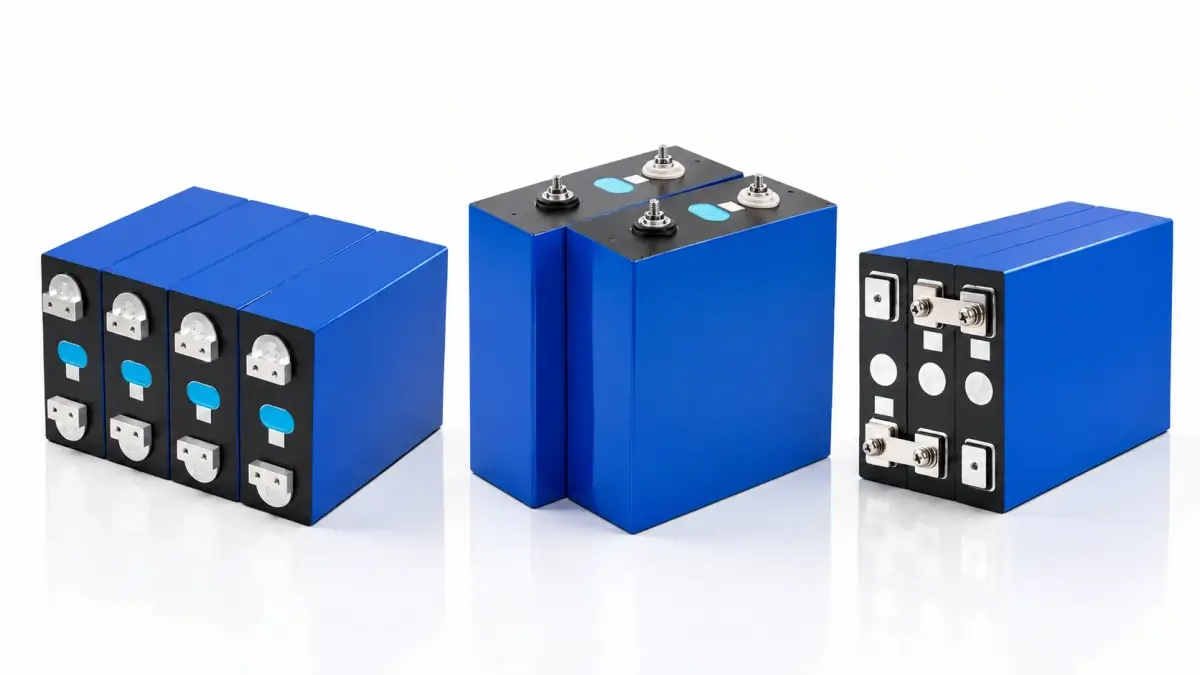
So, what makes prismatic LiFePO₄ batteries a preferred choice for many applications? Let’s explore their key advantages and how to select the right battery for your project.
01. Efficient Space Utilization with a Rectangular Cell Design
One of the most noticeable advantages of prismatic LiFePO₄ batteries is their rectangular structure.
Unlike cylindrical cells, which may leave gaps when arranged together, prismatic cells feature flat surfaces that allow them to be positioned closely inside a suitably designed battery enclosure. This helps make more efficient use of the available installation space.
For industrial equipment, electric vehicles, and stationary power systems, where battery dimensions and internal layout are important, this structural advantage can be particularly useful.
Key benefits include:
- Compact Cell Arrangement: Rectangular cells can be positioned closely to reduce unused space within the battery enclosure.
- Flexible Battery Layout: Different cell dimensions and capacities allow battery manufacturers to design packs around specific equipment requirements.
- Simplified Cell Connections: Larger-capacity cells can reduce the number of individual cells and electrical connections required for a given battery capacity.
- Convenient Module Integration: Regular cell geometry makes it easier to plan battery positioning and enclosure dimensions.
PKNERGY offers prismatic LiFePO₄ battery packs in multiple voltage and capacity configurations, including 25.6V 52Ah, 25.6V 90Ah, 25.6V 100Ah, and 51.2V 100Ah options.
These configurations provide flexibility for customers developing industrial equipment, backup power systems, and customized battery applications.
02. Rigid Cell Structure for Reliable Battery Integration
Prismatic LiFePO₄ cells typically feature a rigid metal casing, commonly made from aluminum or steel, which maintains a defined rectangular shape and protects the internal cell structure.
This hard-shell construction provides practical advantages during battery pack assembly and system integration.
Mechanical Structure
The rigid casing provides physical support for the cell and helps maintain its overall shape. For industrial applications, suitable mounting structures and mechanical protection remain essential.
Organized Electrical Connections
Large-format prismatic cells can reduce the number of individual cells required in a battery pack, helping simplify busbar arrangements and electrical connections.
Flexible Battery Pack Design
Different cell capacities and dimensions make it possible to develop battery packs for different voltage platforms, installation spaces, and discharge requirements.
Practical System Integration
The regular rectangular shape is convenient for arranging cells in industrial cabinets, vehicle battery compartments, and stationary battery enclosures.
At PKNERGY, battery configuration is considered according to the intended application, including cell arrangement, voltage requirements, BMS protection, and enclosure dimensions. This helps ensure that the battery pack is designed around the equipment rather than simply selecting a cell based on capacity.
03. Long Cycle Life for Repeated Charging and Discharging
Cycle life is one of the most important considerations when choosing a lithium battery for industrial and commercial applications.
LiFePO₄ chemistry is known for its relatively stable structure and good cycle durability. When combined with suitable battery management and operating conditions, it can provide dependable performance over repeated charge and discharge cycles.
Several factors influence battery cycle life:
- Charging and Discharging Rates: Operating within the recommended current range helps maintain cell performance.
- Temperature Management: Appropriate temperature control helps prevent unnecessary battery degradation.
- Depth of Discharge: Discharge depth affects the number of cycles a battery can achieve.
- Cell Consistency: Consistent cell performance supports balanced operation across the battery pack.
- BMS Protection: Proper voltage, current, and temperature protection helps keep the battery within its specified operating range.
PKNERGY’s prismatic LiFePO₄ battery range includes selected models rated for 3,000 to 6,000 cycles under their respective standard test conditions.
For example, the 25.6V 90Ah battery is rated for up to 6,000 cycles, while selected 100Ah configurations offer a rated cycle life of 5,000 cycles.
Cycle life depends on test conditions, including temperature, charge/discharge rates, and remaining capacity threshold. Actual performance varies by application.
04. Stable Power Output for Different Equipment Requirements
A battery must do more than store energy. It must also deliver the required current reliably when equipment starts, operates, or encounters sudden changes in load.
This is particularly important for industrial vehicles, electric machinery, and equipment with motors or high-power electrical components.
Prismatic LiFePO₄ battery packs can be configured with different continuous and peak discharge capabilities to meet specific operating requirements.
- Industrial vehicles require sufficient continuous current for regular operation and suitable peak current during acceleration.
- AGVs and automated equipment need reliable power for repeated movement and charging cycles.
- Backup power systems require stable output during power interruptions.
- Specialty machinery may require customized voltage and current configurations.
PKNERGY provides different discharge configurations to suit different applications. Selected products support continuous discharge rates of 0.5C to 1C, with higher short-duration peak discharge capabilities depending on the model.
For customers with specific power requirements, selecting the correct cell configuration, BMS, and electrical connections is essential to achieving reliable battery performance.
05. What Applications Benefit Most from Prismatic LiFePO₄ Batteries?
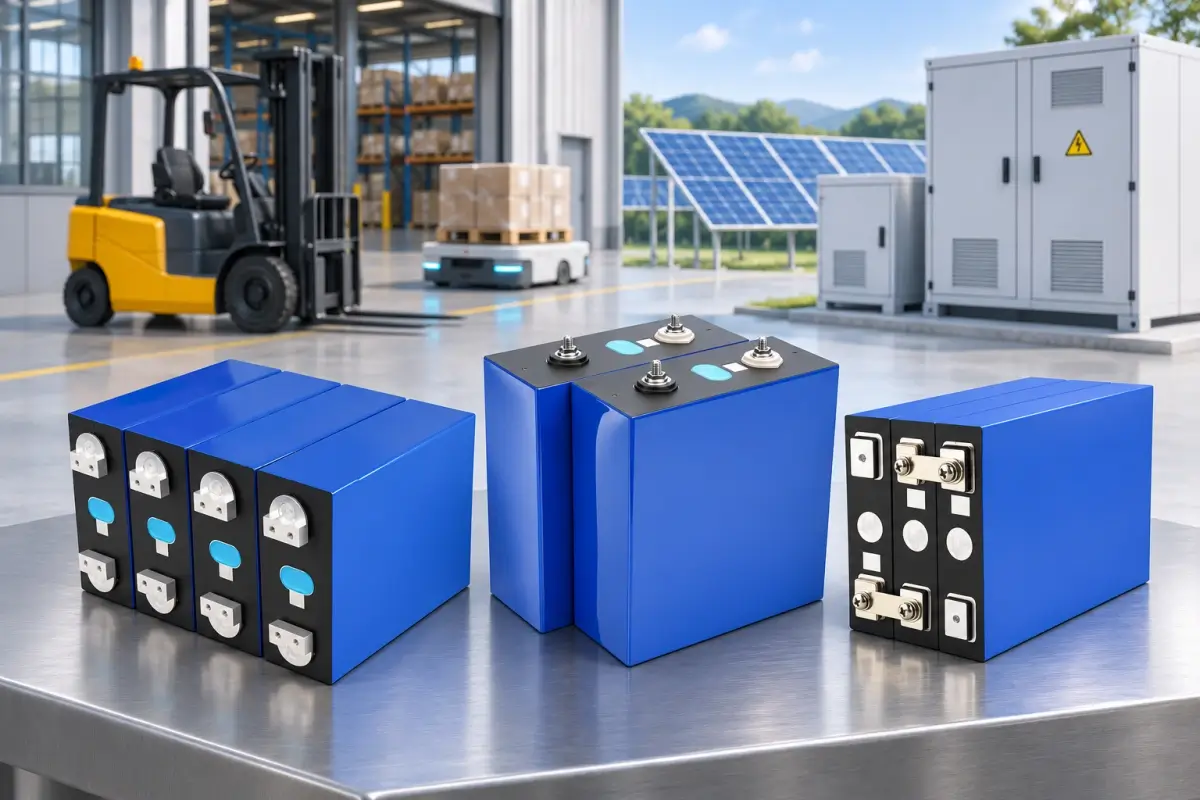
The advantages of prismatic LiFePO₄ batteries extend far beyond residential energy storage. Their rectangular structure, flexible capacity, and configurable voltage platforms make them suitable for a wide range of industrial and specialty applications.
Industrial Vehicles and Material Handling Equipment
Forklifts | AGVs | AMRs | Electric Pallet Trucks
Industrial vehicles often operate for extended periods and require batteries that can withstand frequent charging and discharging.
Prismatic LiFePO₄ battery packs are suitable for these applications because they can be configured to match different voltage platforms, battery compartments, and power requirements.
Common configurations include:
- 25.6V battery packs for smaller industrial vehicles and material handling equipment.
- 51.2V battery packs for forklifts, AGVs, and other industrial vehicles.
PKNERGY offers 25.6V and 51.2V prismatic battery configurations to support different industrial power requirements.
Industrial Backup Power and UPS Systems
Communication Equipment | Industrial Controls | UPS | Backup Power
Industrial facilities and communication equipment require dependable backup power to maintain essential operations during power interruptions.
Prismatic LiFePO₄ batteries can be integrated into backup power systems to provide rechargeable energy for critical equipment.
Typical configurations include 25.6V 100Ah and 51.2V 100Ah or 200Ah, depending on the system’s voltage and backup duration requirements.
PKNERGY’s prismatic LiFePO₄ battery solutions can be considered for industrial backup power applications where stable output, appropriate BMS protection, and system compatibility are essential.
Solar and Off-Grid Energy Storage
Residential Solar | Commercial Storage | Off-Grid Systems
Solar power systems often require batteries to store excess electricity for use when solar generation is unavailable.
Prismatic LiFePO₄ batteries are suitable for repeated energy storage and discharge, making them an option for residential, commercial, and off-grid applications.
Their flexible capacity configurations allow battery designers to develop systems according to energy demand and available installation space.
PKNERGY offers prismatic LiFePO₄ battery packs for different energy storage requirements, with voltage and capacity options that can be evaluated according to inverter and system specifications.
RV, Marine and Mobile Power Systems
Recreational Vehicles | Boats | Yachts | Mobile Equipment
RV and marine applications require dependable batteries for lighting, appliances, navigation equipment, and onboard electrical systems.
Compared with traditional lead-acid batteries, LiFePO₄ battery packs can offer longer cycle life, reduced routine maintenance, and lower weight for comparable usable energy in many configurations.
Typical voltage platforms include 12.8V, 25.6V, and 51.2V.
PKNERGY’s prismatic battery technology provides a foundation for different mobile power configurations. For marine applications, the complete battery design should also account for vibration, moisture, corrosion resistance, and charging compatibility.
Specialty Industrial Equipment
Cleaning Machines | Agricultural Machinery | Golf Carts | Electric Utility Vehicles
Many specialty machines require battery packs designed around their specific electrical and mechanical requirements.
Prismatic LiFePO₄ cells offer flexible capacity and voltage combinations for developing battery solutions for equipment with different operating times, power demands, and installation dimensions.
PKNERGY supports different battery configurations for customers seeking suitable power solutions for specialized equipment.
06. Prismatic vs. Cylindrical LiFePO₄ Batteries: What Is the Difference?
Both prismatic and cylindrical LiFePO₄ batteries have advantages. The choice depends on the application, battery pack design, installation space, and performance requirements.
| Comparison | Prismatic LiFePO₄ | Cylindrical LiFePO₄ |
|---|---|---|
| Cell Structure | Rectangular metal casing | Round metal casing |
| Space Utilization | Efficient in rectangular layouts | Gaps may remain between cells |
| Individual Cell Capacity | Commonly available in larger capacities | Often smaller per cell |
| Cell Connections | Fewer cells may be needed | More individual cells may be required |
| Pack Design | Suitable for large-format battery modules | Flexible modular pack arrangements |
| Typical Applications | Industrial batteries, EVs, energy storage | Consumer electronics, industrial equipment, modular packs |
Prismatic cells are often selected when a battery pack requires larger individual cell capacities and an organized rectangular layout.
Cylindrical cells can be advantageous when standardized cell dimensions, modular construction, or particular thermal and mechanical requirements are priorities.
At PKNERGY, prismatic and cylindrical LiFePO₄ battery formats serve different product requirements. Selecting the appropriate format depends on the customer’s application rather than assuming one design is suitable for every project.
07. PKNERGY Prismatic LiFePO₄ Battery Range
PKNERGY provides prismatic LiFePO₄ battery packs in different voltage and capacity configurations for industrial equipment, backup power, energy storage, and specialty applications.
Our product range covers compact battery configurations as well as higher-capacity options, allowing customers to select products according to their equipment and operating requirements.
| Battery Configuration | Capacity | Continuous Discharge | Cycle Life |
|---|---|---|---|
| 25.6V 52Ah | 52Ah | 52A | 3,000 cycles |
| 25.6V 90Ah | 90Ah | 90A | 6,000 cycles |
| 25.6V 100Ah | 100Ah | 50A | 5,000 cycles |
| 51.2V 52Ah | 52Ah | 52A | 3,000 cycles |
| 51.2V 100Ah | 100Ah | 50A | 5,000 cycles |
Cycle life figures are based on supplied standard test information at 80% SOC. Actual performance depends on operating conditions and battery configuration.
From cell selection to battery pack configuration, PKNERGY focuses on providing practical LiFePO₄ battery solutions that match real application requirements.
Whether you are sourcing batteries for industrial vehicles, backup power systems, or specialty equipment, our team can help evaluate voltage, capacity, discharge current, and battery dimensions to identify a suitable configuration.
08. Frequently Asked Questions About Prismatic LiFePO₄ Batteries
Q1. What is the biggest advantage of prismatic LiFePO₄ batteries?
One of their main advantages is efficient space utilization. Their rectangular structure allows cells to be arranged closely in a suitably designed battery enclosure. Combined with the cycle durability of LiFePO₄ chemistry, this makes them suitable for industrial equipment, backup power, and energy storage applications.
Q2. Do prismatic LiFePO₄ batteries have a longer cycle life than cylindrical batteries?
Not necessarily. Cycle life is primarily influenced by cell chemistry, manufacturing quality, operating temperature, charge/discharge rates, and depth of discharge. Both prismatic and cylindrical LiFePO₄ batteries can offer long cycle life when properly designed and operated.
Q3. Are prismatic LiFePO₄ batteries suitable for forklifts and AGVs?
Yes. They can be integrated into battery packs for electric forklifts, AGVs, AMRs, and other material handling equipment. The battery must be selected according to the vehicle’s nominal voltage, continuous discharge current, peak current, operating time, and charging requirements. PKNERGY offers different prismatic battery configurations for industrial applications.
Q4. What capacity options are available for prismatic LiFePO₄ batteries?
Common prismatic LiFePO₄ cell capacities include 52Ah, 90Ah, 100Ah, 200Ah, 280Ah, and 314Ah. The final battery pack capacity depends on the selected cell and series/parallel configuration. PKNERGY’s current battery configurations include 52Ah, 90Ah, and 100Ah models, with other capacity options available for evaluation.
Q5. Are prismatic LiFePO₄ batteries suitable for solar energy storage?
Yes. They can be used in residential solar, commercial energy storage, and off-grid power systems. Their capacity flexibility and cycle durability make them suitable for repeated energy storage and discharge. Battery voltage, BMS communication, and inverter compatibility should be checked before integration.
Q6. What is the difference between 48V and 51.2V LiFePO₄ batteries?
A standard 16S LiFePO₄ battery has a nominal voltage of 51.2V because each cell has a nominal voltage of 3.2V. Some products are marketed as 48V batteries because they are designed for 48V-class equipment and systems. Always confirm the complete operating voltage range before purchasing.
Q7. Can prismatic LiFePO₄ batteries replace lead-acid batteries?
In many applications, yes. They can be used as alternatives in compatible industrial equipment, backup power systems, RVs, and marine applications. However, the battery voltage, charging profile, dimensions, BMS protection, and discharge requirements must be checked before replacement.
Q8. How do I choose the right prismatic LiFePO₄ battery?
Start by confirming the following requirements:
- Nominal voltage and rated capacity.
- Continuous and peak discharge current.
- Required operating time.
- Charging method and charging current.
- Battery dimensions and installation space.
- Operating temperature range.
- BMS protection and communication requirements.
PKNERGY can use these details to help evaluate a suitable battery configuration for your application.
PKNERGY LiFePO₄ Battery Solutions
Looking for a Reliable Prismatic LiFePO₄ Battery?
Contact PKNERGY to discuss your voltage, capacity, discharge current, and application requirements. Our team can help you explore a suitable prismatic LiFePO₄ battery solution.
